
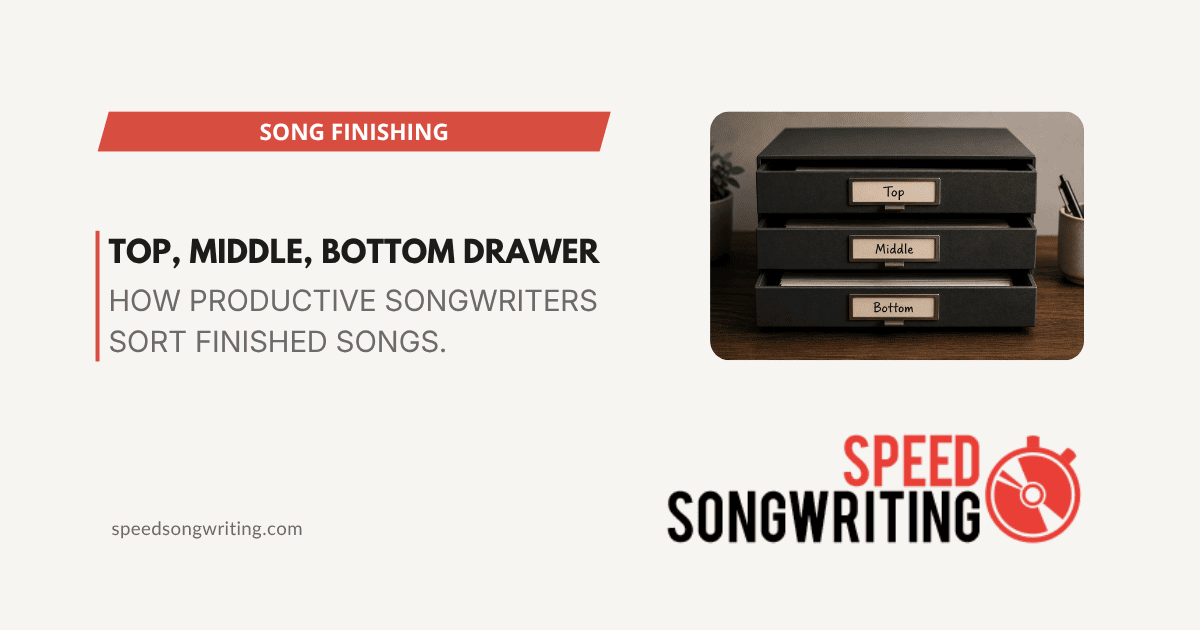
Treating every song like it deserves equal attention is one of the fastest ways to get stuck.
You finish a song (or get close)... set it aside... start another... repeat. Your finished songs are intermingled with unfinished ones, and you're asking the same question: Are they any good?
That question gets heavier the longer it goes unanswered. Eventually it starts following you into new writing sessions. The pressure of "this one has to be great" becomes the reason nothing gets finished.
The drawer system is what fixes that. It's Step 7 of the Speed Songwriting System: Edit, Stop Tweaking, and Sort. And sorting is the part most people skip, which is why most people stay stuck.
What the Drawer System Is
The drawer system is a three-category framework for evaluating finished songs. Top Drawer, Middle Drawer, Bottom Drawer. Every song you complete goes into one of them.
That's it. The sorting itself takes about thirty seconds. What it does for your writing practice is harder to measure but immediately felt: it closes the loop on each song so you can start the next one clean.
The question isn't "is this a good song?" That's too vague to answer and too loaded to be useful. The question is: "which drawer does this go in?" That question has a specific answer, and it doesn't carry any shame with it.
Top Drawer
Top drawer songs are exceptional. They're fully realized: the lyric is tight, the emotional arc lands, the hook is memorable, and the song does what it set out to do. These are the songs that surprise you when you play them back. The ones where the writing brain and the editing brain both signed off.
Criteria for top drawer:
- The chorus delivers its emotional payoff completely
- The lyric rhythm feels natural all the way through, with no lines where you're forcing syllables
- The specific details in the verse make the chorus feel earned
- You'd play it for someone right now without apology
When a song makes the top drawer, the next step is recording it. Move it forward. This is the song that belongs in your publishing process, your pitch list, your release calendar. Top drawer songs are ready-to-develop.
Top drawer is also rarer than most songwriters expect when they start. And that's fine. The drawer system isn't a test. It's a filing system.
Middle Drawer
Middle drawer songs are the backbone of a productive songwriter's catalog.
A middle drawer song is good. Solid. It has a strong section or two, a real idea at its center, and something worth keeping, even if the whole thing isn't fully realized. Maybe the chorus is strong but the second verse runs out of steam. Maybe the lyric is serviceable but the concept could go deeper. Maybe it's not your finest emotional work but it has commercial utility.
Criteria for middle drawer:
- At least one section (usually the chorus) is working well
- The song has a clear concept and a direction, even if the execution isn't complete
- It could have a use: licensing, a pitch for another artist, a writing exercise that went somewhere interesting
- With a rewrite or a different musical treatment, it could move up
Most of what you write will end up in the middle drawer. That's not a consolation — that's the catalog. Middle drawer songs earn. They license to film and TV. They get pitched to artists. They develop over time with fresh ears into top drawer songs. The songwriters who build catalogs are building middle drawer catalogs, not waiting for a folder full of top drawer material.
The middle drawer also functions as a holding place for songs that need time. Set it aside. Come back in a week. What felt like a flaw in the writing session might reveal itself as the song's best moment with a little distance.
Bottom Drawer
Bottom drawer songs are learning experiences.
The bottom drawer is where the system sends the songs that didn't come together this time: the ones where the concept wasn't strong enough, the execution didn't match the intention, or the idea simply ran out of runway. Every productive songwriter has a full one. It's proof they're writing consistently enough to generate the range.
Criteria for bottom drawer:
- The concept isn't landing, or there isn't one
- No single section feels worth developing further
- The song served its purpose in the session but doesn't have legs beyond it
When a song goes in the bottom drawer, ask two questions before you close it. First: is any one section, phrase, or lyric worth saving for a future song? A single line can be the seed of something strong. Steal it and archive the rest. Second: what did this song teach you? Bottom drawer songs are the ones that sharpen the skills that show up in top drawer songs later.
The bottom drawer is not a graveyard. It's a compost pile. Everything in it is feeding the next thing.
The Re-Sort Rule
Regardless of which drawer a song goes into, set a reminder to listen back in one week.
Fresh ears change everything. A chorus that felt weak in the writing session, when you were tired and you'd heard it forty times, can hit differently six days later when you haven't thought about it. A song you were proud of in the moment can reveal a flaw you missed. The re-sort is how the system self-corrects.
The re-sort questions are: Has the sorting changed? What is this song actually good for? Should it be pitched? Recorded? Developed further? Filed away?
One week, one listen, one decision. Then move on.
What Sorting Actually Does
The drawer system isn't just an organizational tool. It's a psychological one.
When you know every finished song will be sorted, when sorting is a guaranteed step in the process, the pressure inside the writing session changes. You're not writing a song that has to be great. You're writing a song that will be evaluated by clear criteria after it's done. The evaluation happens later. Right now, the job is finishing.
That shift is more significant than it sounds. Perfectionism lives in the writing session. It's the voice that says the song isn't good enough yet, so why finish it? The drawer system moves the judgment to its proper place: after the work is done, not during it. The writing session is for writing. The drawer is for sorting. Those are two different jobs, and keeping them separate is what makes both possible.
One More Thing About the Drawer System
Professionals sort because sorting is what lets them keep writing.
The songwriter who never sorts carries every unresolved song into every new session. The weight accumulates, starting new things gets harder, and the folder gets heavier. The question gets louder and less answerable: is any of this good enough?
The drawer system makes the question answerable. It tells you, specifically, what to do with this song right now. And once that's settled, the next song can start clean.
Keep Going
The drawer system is Step 7 of the 7-Step Speed Songwriting System. Read the full system breakdown here.
If you're not finishing enough songs to sort, Why You Can't Finish Songs covers the real reason and the one shift that fixes it.
Graham English is the creator of Speed Songwriting, a Berklee-certified Songwriting Master, and the bestselling author of Logic Pro For Dummies. He helps songwriters finish better songs faster, without burnout, perfectionism, or endless rewriting.
The 7-Step Method That Helps You Actually Finish a Song
Most songwriters have more ideas than finished songs. This free guide shows you the exact sequence to take an idea from start to done — without the rewriting loop or the blank-page panic.
Enter your name and email and I'll send it right to your inbox.
No spam. Just useful things for songwriters.
Leave a Reply