

You don't abandon most songs at random.
If you think back through the ones that went quiet...
The ideas that felt real for a day or a week and then disappeared...
Most of them didn't die in the opening bars. They didn't die in the veunfrse. They made it all the way to the moment the song was supposed to become undeniable.
And then they stalled.
That moment is almost always the chorus.
Why So Many Songs Stall in the Same Place
Here's what the experience usually feels like. The verse comes together faster than you expected. There's a melodic idea that actually works, a lyric angle that feels fresh, enough momentum to keep you moving forward.
The track is building, and you're thinking this might be the one.
Then you reach the chorus, and the forward motion suddenly gets heavy. You can feel the song trying to arrive somewhere, but it doesn't quite get there. So you try a different chord, adjust the melody, rewrite the lyric, load a new drum sample to see if the energy changes… and slowly, without making any single decision to stop, you just stop. The session saves, the project folder closes, and the song joins the folder.
If this sounds like a familiar loop, it probably is. Most songwriters who struggle to finish songs have the same folder: twenty-something ideas, all with strong beginnings, most of them abandoned somewhere near the chorus.
The conventional explanation is that this is a motivation problem, or a perfectionism problem, or a discipline problem. But most of the songwriters I know who deal with this are neither lazy nor undisciplined. They care a lot, which is usually why they stop. They care enough to know that what they've written isn't working, and they don't yet have a clear way forward.
The problem is almost always structural. Specifically, it's in the chorus.
The Problem Usually Isn't Motivation
When a song gets abandoned, the easy diagnosis is that the writer lost steam, lost interest, or didn't push through. And maybe sometimes that's true. But in most cases, the writer didn't stop because they stopped caring. They stopped because the song stopped making sense to them.
That's a different problem with a different solution.
Motivation responds to clarity. When you know what a section needs to do and you have a way to build it, motivation follows from the work itself. Sessions feel good when they're moving, and they feel bad when they're not. The question is: what makes them stop moving?
The answer, more often than not, is a chorus that hasn't resolved the promise of the song.
Perfectionism, self-doubt, and indecision are real experiences, but they're usually symptoms. When a chorus is structurally clear, does its job cleanly, and gives you something to build the rest of the song around, most of those symptoms disappear.
You know what comes next because the chorus is telling you. When the chorus is vague or structurally weak, there's nowhere to go, the song loses its logic, and the writer loses confidence… and that's when the session becomes painful, and that's when songs get abandoned.
It's not a willpower failure. It's a structural one.
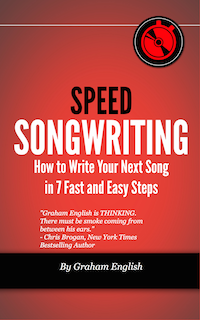
The 7-Step Speed Songwriting System: Write Better Songs Faster (Start Here)
Why the Chorus Carries More Weight Than Most Writers Realize
The chorus has an outsized job in a song. Most writers understand this in theory, but it's easy to underestimate just how much the chorus is holding up.
A chorus that works needs to do at least four things at once.
It has to clarify the emotional center. The chorus should tell us what the song is really about — not just lyrically, but melodically and rhythmically. The listener should come away from the chorus knowing what they're inside.
It has to create memorability. This is where the listener latches on. If there's a part of the song that someone hums three days later, it's almost always the chorus. That memorability comes from clarity of melodic shape and rhythmic identity.
It has to deliver contrast. The chorus should feel like an arrival, not just a continuation of the verse with different lyrics. That arrival comes from a genuine change in melodic behavior, not just a production lift.
It has to justify finishing the song. This is the one most writers don't think about explicitly, but it's the most important for the finishing problem. If a chorus doesn't feel worth building a whole song around, the writer loses faith in the song fast. Every choice after that point gets harder. Every lyric in the second verse feels harder to write because you can't hear what it's building toward. Every production decision feels harder because you're not sure if the song is even worth finishing.
A chorus that works gives the writer faith that the song is real. A chorus that doesn't quietly signals that the whole project might be on shaky ground, and most writers respond to that signal by walking away.
5 Reasons Unfinished Songs Die in the Chorus
Understanding that the chorus is the problem is useful. Understanding why is more useful.
1. The chorus doesn't feel different enough from the verse.
This is the most common structural failure. Many writers accidentally build a verse and a chorus with the same melodic energy, the same phrase length, the same sense of motion. When every section behaves the same way, the song never arrives anywhere. It just continues. A listener can feel the difference between a chorus that arrives and one that merely begins, even if they can't name it. The writer feels it too, which is why the song stops moving.
2. The hook isn't clear enough.
Not necessarily weak, but just not obvious enough, not central enough, not easy to hold onto. A hook that's trying to do too much, or one that's buried in a melody with no clear landing point, can't carry the weight a chorus needs to carry. The listener can't find what to remember, and if the listener can't find it, the writer can't either.
3. The melody gets prettier instead of stronger.
This is a contrarian point worth sitting with. When a chorus isn't landing, many writers instinctively reach for more melodic complexity, more movement, more notes, more musicality. But a chorus doesn't need to be more musical, it needs to be more functional. Strength in a chorus comes from clarity and rhythmic identity, not from decoration. A chorus that's trying to be beautiful often forgets to be clear.
4. The chorus has too many ideas competing at once.
Too many lyric thoughts, too much melodic movement, too many things happening rhythmically. The listener can't land on anything, and the center of the chorus disappears into the busyness. A chorus that's trying to say three things usually says none of them well. One strong idea, clearly expressed, carries a song further than four half-formed ones.
5. The writer starts judging too early.
This one crosses from structure into process, but it belongs here because it always shows up at the chorus. The verse can survive some early judgment, because the writer is still building. But the chorus is where everything has to arrive, and that pressure activates self-evaluation too soon. The writer starts comparing the draft chorus to a finished song by a professional, or to some ideal chorus they've imagined but can't yet produce. The draft collapses under that comparison, and the song never gets a real chorus because judgment arrived before the draft was done.
What a Weak Chorus Really Costs You
The obvious cost of a weak chorus is a chorus that doesn't land. But the real cost is everything that happens after.
When the chorus doesn't resolve, writers respond by endlessly rewriting the verse, as if the verse were the problem. They change the production, adding layers to compensate for a structural gap that more reverb won't close. They doubt the entire concept of the song and start wondering if the original idea was ever any good… and then they abandon songs that were actually fixable, not because the song was beyond saving, but because the chorus hadn't yet been built into something worth saving.
The folder full of unfinished songs isn't evidence of a character flaw. It's evidence of a recurring structural problem that never got diagnosed correctly.
Most of those songs don't need to be restarted from scratch. They need a chorus that actually works.
5 Better Questions to Ask Before You Abandon a Song
Instead of asking "is this good?" or "would people like this?" or "why can't I finish anything?" — which are questions that go nowhere — try these.
What is the chorus trying to do? Not lyrically, but structurally. What is it supposed to feel like when the listener arrives there?
What is the listener supposed to remember? If you can't answer this, the chorus doesn't have a center yet.
Does this actually feel like arrival? Strip the production and hum the melody. Does it feel like you've landed somewhere, or does it feel like the verse with different words?
What are the strongest two bars? Find them and protect them. Everything else in the chorus should support those two bars, not compete with them.
What can I remove to make the center clearer? A chorus that's working rarely has too little. It usually has too much.
These questions won't finish the song for you. But they'll tell you whether you're dealing with a broken song or a chorus that hasn't been built yet. That's a more useful diagnosis than "I need more inspiration."
Finishing Songs Gets Easier When the Chorus Gets Clearer
A lot of unfinished songs are not evidence that you lack talent. They're evidence that you're reaching the most structurally important part of the song without a clear way to build it.
That's not a permanent condition. It's a skill gap, and skill gaps can be closed.
Once you can hear what a chorus is supposed to do — how it should behave differently from the verse, what makes it memorable, what structural clarity actually feels like from the inside — finishing songs gets a lot less mysterious. The second verse stops being a guessing game because the chorus is telling you what it needs, and the bridge stops being a crisis because the song has a logic now.
Most of the writers who think they're bad at finishing songs aren't. They're good at starting songs and underprepared for the moment the song has to become something.
That moment is always the chorus.
I'll be writing more about exactly what a chorus needs to do — and what it means to build one structurally rather than hoping it arrives on its own. If this resonated, it's probably worth staying close to the next few pieces.
If you want a starting point in the meantime, the Speed Songwriting Cheat Sheet gives you the clearest framework I know for approaching songs with structure instead of guesswork.
Your Speed Songwriting Coach,
Graham English
The 7-Step Method That Helps You Actually Finish a Song
Most songwriters have more ideas than finished songs. This free guide shows you the exact sequence to take an idea from start to done — without the rewriting loop or the blank-page panic.
Enter your name and email and I'll send it right to your inbox.
No spam. Just useful things for songwriters.
Leave a Reply