
Why do some songwriters finish a song in an afternoon while others stall out for months on the same idea?
It's not because of talent, inspiration, or even discipline.
The songwriters who finish know where the song is going before they write a word. The ones who stall are writing into a void, hoping the song figures itself out.
It usually doesn't.
Song plots fix that.
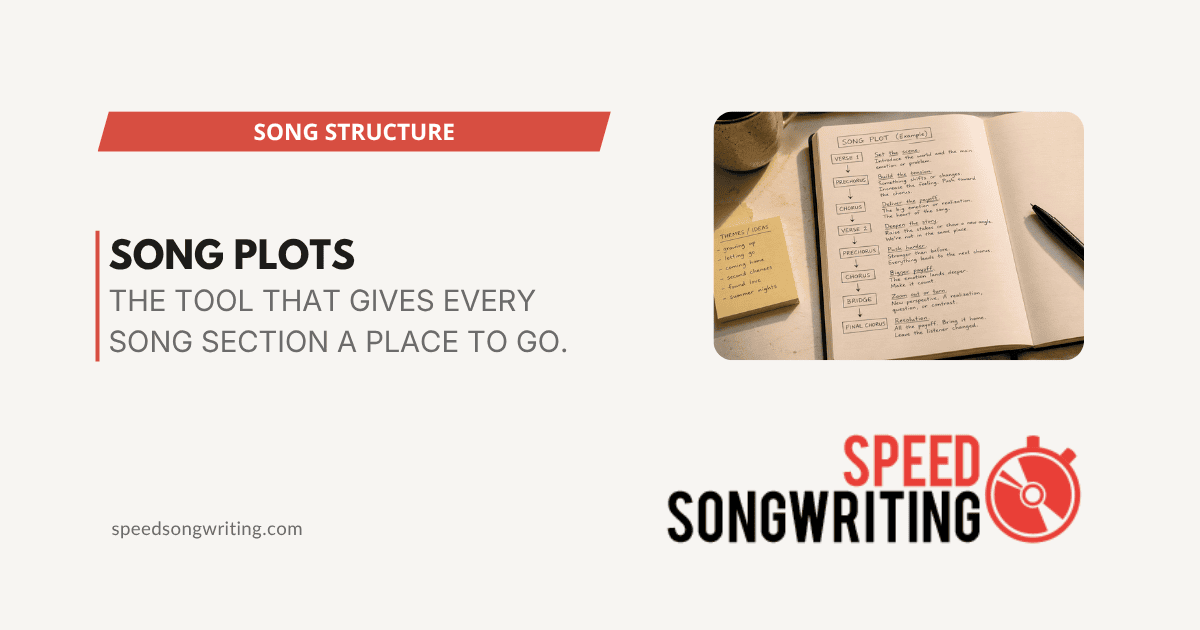
A song plot is an emotional and narrative outline: one sentence per section that describes what each part of the song does.
It gives your song a direction before you write a word. And because the direction is set, the blank page stops being a problem.
One plot can generate an infinite number of songs. The same plot that drove "My Girl" can drive a song you write today, about something completely different, and the two songs will sound nothing alike.
Here's the concept, the five plots built into the Speed Songwriting System, and how to use them.
What a Song Plot Is
A song plot is an emotional and narrative outline: one sentence per section that describes what each part of the song does.
Think of it as a song archetype. The same patterns show up across genres and decades because they map to the way human beings process emotion and story:
- Verse sets up the world.
- Prechorus shifts the tension.
- Chorus delivers the payoff.
- Bridge zooms out.
What changes from song to song is the specific content inside those sections. The plot stays the same. The words, images, characters, and situations are different every time.
That's how one plot generates an infinite number of songs.
How to Reverse-Engineer a Song Plot
You can discover new song plots by working backward from songs you already know. The process has three steps:
- Take the lyrics from a song you admire
- Boil each section down to its meaning and purpose
- Describe that purpose in one sentence
The Temptations' "My Girl," written by Smokey Robinson and Ronald White, is a clean example. Break it down:
Verse: The singer tells you how he feels. "I've got sunshine on a cloudy day."
One sentence: This is how I feel.
Prechorus: The singer asks a question to the audience, or to himself. "I guess you'd say, what can make me feel this way?"
One sentence: I'll tell you why I feel this way.
Chorus: The singer answers the question. "My girl."
One sentence: This is why I feel this way.
That three-sentence outline (how I feel / why I feel this way / this is why I feel this way) is a complete song plot. You could write a hundred songs from it and none of them would sound like "My Girl."
Try this with any song. Three to five sentences, one per section. The plot becomes visible quickly.
The 5 Song Plots
The Speed Songwriting System uses five plots. They cover the most common emotional and narrative arcs in popular songwriting. Each one works across genres and subjects.
| Plot | Verse | Prechorus | Chorus | Bridge |
|---|---|---|---|---|
| #1 | The problem | Can the problem go away? | Life without the problem | The challenge to overcome |
| #2 | The way things used to be | Is there hope? | The way things are now | It'll be okay |
| #3 | The way I wish things were | Is there hope? | Reality check | Uplift or hard truth |
| #4 | What happened | Forget what happened | What's about to happen | The big realization |
| #5 | How I feel | Why I feel this way | This is why I feel this way | Deepen the feeling |
Here's what each one does in practice.
Plot #1: The Problem
Verse: The problem
Prechorus: Can the problem go away?
Chorus: Life without the problem
Bridge: The challenge to overcome
This is the relief plot. The verse describes the problem in full. The prechorus turns toward hope. The chorus imagines life on the other side of the problem. The bridge acknowledges the work it takes to get there.
Quick outline:
- Verse: I've been carrying this weight for years
- Prechorus: What would happen if I put it down?
- Chorus: No more problems
- Bridge: I had to learn to let go first
That contrast, problem in the verse and freedom in the chorus, is what makes the listener lean in.
Plot #2: The Way Things Used to Be
Verse: The way things used to be
Prechorus: Is there hope?
Chorus: The way things are now
Bridge: It'll be okay
This is the change plot. The verse lives in the past. The chorus lives in the present. The gap between them is the emotional engine of the song.
The chorus can be positive or negative, but whichever it is, the verse contrasts it. Positive chorus? The verse describes how things used to be worse. Negative chorus? The verse describes how things used to be better.
Quick outline — positive chorus:
- Verse: Life wasn't always like this
- Prechorus: But things do change
- Chorus: Life is good now
- Bridge: It'll be okay
Quick outline — negative chorus:
- Verse: We used to have everything
- Prechorus: Is there any way back?
- Chorus: Look at us now
- Bridge: We'll find our way through
Same plot structure. Opposite emotional direction. Both work.
Plot #3: The Way I Wish Things Were
Verse: The way I wish things were
Prechorus: Is there hope?
Chorus: Reality check
Bridge: Uplift or hard truth
This is the contrast plot, and it runs the reverse of Plot #2. The verse describes the ideal. The chorus delivers the reality. The prechorus holds the tension between them.
Quick outline:
- Verse: I picture us back the way we were
- Prechorus: Is there any chance?
- Chorus: But that's not how this ends
- Bridge: Some things you have to let be true
The verse establishes longing. The chorus punctures it, or complicates it. The bridge decides whether to land on acceptance or fight.
Plot #4: What Happened
Verse: What happened
Prechorus: Forget what happened
Chorus: What's about to happen
Bridge: The big realization
This is the action plot. It moves through time: past in the verse, letting go in the prechorus, the future in the chorus. The bridge delivers the lesson.
Because time is moving across sections, tense consistency matters. Keep each section anchored to its moment.
Quick outline:
- Verse: We spent the whole night arguing
- Prechorus: Forget all that
- Chorus: We're starting over tonight
- Bridge: Fighting was always just fear talking
This plot suits titles with energy and motion in them: anything that implies something is happening or about to change.
Plot #5: How I Feel
Verse: How I feel
Prechorus: Why I feel this way
Chorus: This is why I feel this way
Bridge: Deepen the feeling
This is the feeling plot, and it's the oldest structure in popular songwriting. "My Girl" runs on it. So does almost every classic R&B ballad. The singer leads with an emotional state and then explains it, section by section.
Quick outline:
- Verse: I feel like I'm finally home
- Prechorus: You want to know why?
- Chorus: Because of you
- Bridge: I didn't know what home felt like until now
The bridge is optional in Plot #5, or it can deepen the feeling rather than redirect it: a second layer of the same emotional truth rather than a contrasting one.
One Plot, Infinite Songs
The same plot doesn't produce the same song twice. The plot handles direction. Content handles everything else.
Plot #1 could yield a song about addiction, a breakup, a bad job, a chronic illness, a city you finally left: anything that qualifies as a problem with a life on the other side of it.
Every one of those songs sounds different because the specific images, characters, and details are different. The plot just keeps the narrative from collapsing in on itself.
You can also mix plots. The prechorus from Plot #2 — "Is there hope?" — slides into Plot #1 without friction. The bridge from Plot #3 — "Uplift or hard truth" — works in Plot #5 when the feeling needs a harder landing.
Once you know the five plots, you start to see them as modular: sections you can borrow and reassemble as the song requires.
One More Thing About Song Plots
Writer's block is usually a navigation problem.
The raw material is almost always there: an emotion, a situation, a line that won't leave you alone.
What's missing is the sense of where the song goes next. The verse ends, and there's nothing pulling you toward the prechorus. The chorus exists, but the bridge has nowhere to come from.
Song plots solve that structurally. When you know the verse is about the problem, and the chorus is about life without it, you always know what the next section needs to do. The navigation problem disappears. And when you always know where you're going, you write.
Keep Going
Song plots are Step 1 of the 7-Step Speed Songwriting System. Read the full system breakdown at The 7-Step Speed Songwriting System.
Once your plot is set, Step 2 is building your word bank with the Lyric Triad.
For ten more plot variations to expand your range, 10 Amazing Song Plots to Inspire Your Songwriting Right Now has you covered.
The 7-Step Method That Helps You Actually Finish a Song
Most songwriters have more ideas than finished songs. This free guide shows you the exact sequence to take an idea from start to done — without the rewriting loop or the blank-page panic.
Enter your name and email and I'll send it right to your inbox.
No spam. Just useful things for songwriters.