
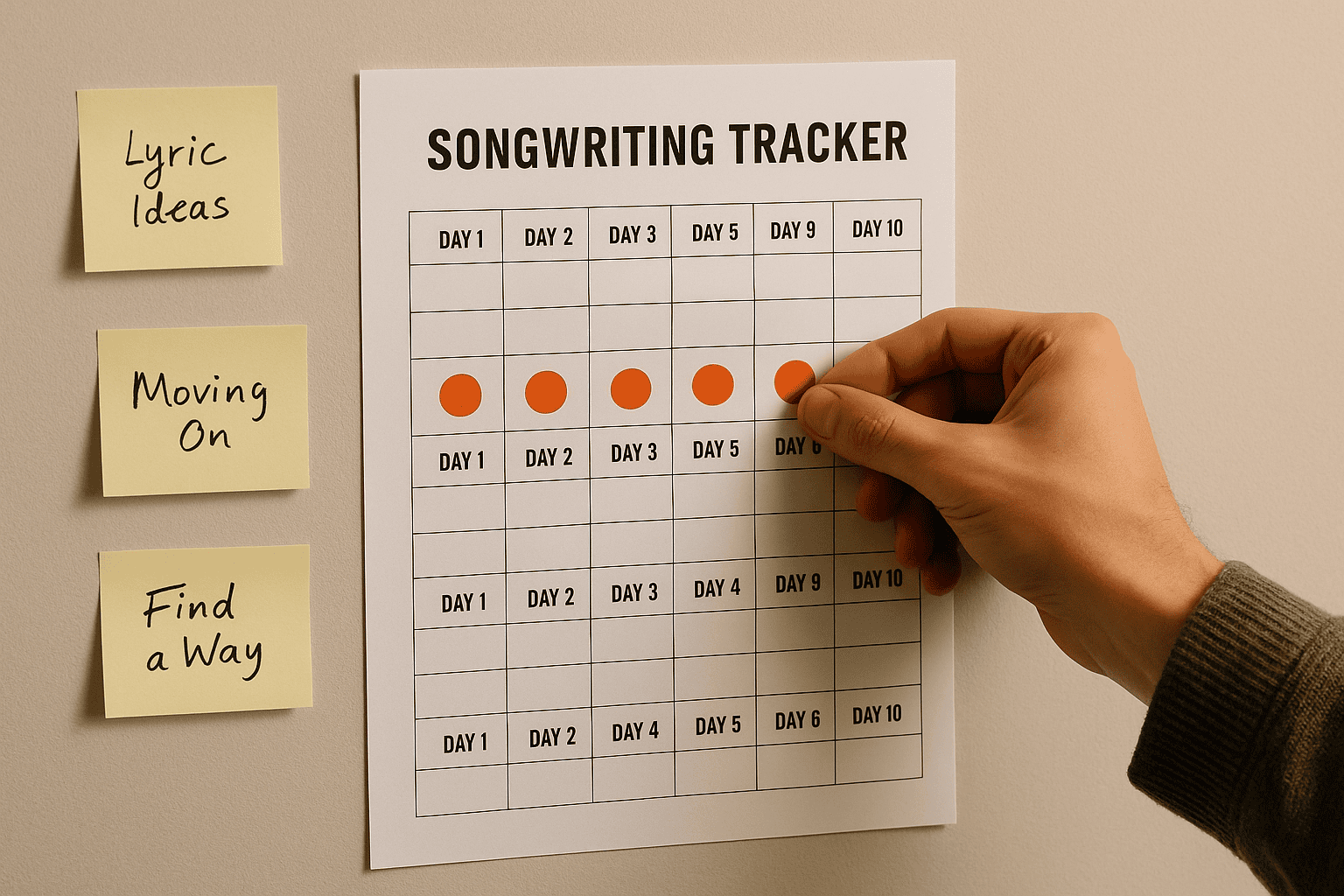
You don’t need a three-hour morning ritual, a fancy studio, or a surge of divine inspiration to finish songs consistently.
You need a rhythm. A repeatable groove that fits into your life, like coffee in the morning or brushing your teeth before bed.
We don't have endless hours. But we can use the time we do have on purpose.
Below are seven concrete routine hacks that help you start, stick, and finish, no matter how busy or blocked you feel.
1. Anchor Your Writing to Something You Already Do
Start by attaching your writing to a habit that already happens automatically.
That might be:
- After your morning coffee
- Right after you walk the dog
- As soon as you close your laptop at the end of work
Don't think of it as adding something new to your already busy schedule. Think of it as piggybacking on something your brain already recognizes and can complete.
To get started, follow these 3 simple steps:
- Pick one action you do every day (make coffee, brush your teeth, open your laptop).
- Decide on a short creative behavior you’ll do immediately after it (open voice memo app, write one lyric line, hum a melody).
- Celebrate it! Yes, actually smile or nod or say "Boom!" aloud.
This is a core part of the Tiny Habits method. Instead of waiting for motivation, you're programming momentum.
2. Use a 3-Minute Warm-Up to Kill the Blank Page
One of the biggest obstacles to consistency? Staring at the void.
Don’t start your session cold. Prime your brain with a short, creative warm-up.
Here’s what to do next:
- Set a timer for 3 minutes
- Freewrite lyrics using a random word prompt (like “sky” or “if only”)
- Or play random chords and hum nonsense melodies
The point isn’t to be a brilliant writer, but to ignite your passion for writing.
Think of it like tuning your instrument, your voice, and your mindset. You’re signaling to the brain: “It’s writing time now.”
Keep a separate notebook or folder called “Warm-Ups.” You’ll be surprised how often these scraps become full songs later.
3. Pre-Decide What You’ll Work On (The Night Before)
When the clock’s ticking and your brain’s fried, decision fatigue kills creativity.
You need a plan before you sit down.
Each night, take 30 seconds to write a sentence like:
- “Tomorrow, I’ll sketch a chorus idea for that soulful ballad.”
- “Tomorrow, I’ll polish the verse for ‘Fire Escape Weather.’”
- “Tomorrow, I’ll record a scratch melody for the second verse.”
One clear target. No ambiguity.
Keep a sticky note on your keyboard, or set a phone reminder with that sentence. You’ll slide straight into your session with zero friction (before your brain has time to argue).
4. Limit Your Session to 25 Minutes (Yes, Seriously)
Short bursts create long-term consistency. You don’t need 24 hours of adrenaline-filled sleepless writing. You only need twenty focused minutes to move the song forward.
Set a timer. When it goes off, stop.
This constraint does two things:
- It removes pressure to be perfect.
- It makes it easy to return tomorrow.
Don’t try to force a full masterpiece in one sitting. Lay bricks (one solid chunk at a time).
Over a week, those 25-minute bricks build something real:
- Monday: freewrite ideas
- Tuesday: sketch a chorus
- Wednesday: write a verse and prechorus
- Thursday: edit it
- Friday: record a rough demo
Instead of obsessing over one chorus for three hours, you’ll actually move.
5. Use a Rotating 3-Day Cycle to Stay Fresh
If you get bored easily or stuck on one song for too long, use this rotation system:
Day 1 – Start Something New
Brainstorm titles and sketch melodies. There's no pressure to finish anything. Just generate ideas with reckless abandon.
Day 2 – Move an Existing Song Forward
Pick something you started recently and add a verse or refine a melody. Build on top of your investments.
This matters if your brain works like mine. I’ve got ADHD, which means a Maserati brain with tricycle brakes. Ideas come fast. Finishing used to be the hard part. This rotation gives your brain novelty and closure, without forcing either.
Day 3 – Finish or Archive
Decide: Is this worth finishing? If yes, tighten it. If no, save and move on.
This cycle keeps you creatively fresh without getting scattered. You always know what kind of energy to bring to each day. New, build, or wrap.
6. Keep a “Next Line” List in Your Notes App
Ever had a lyric pop into your head while driving or doing dishes?
Capture it. But more importantly, label it as a “next step.”
In your Notes app or songwriting journal, start a running list:
- “Next hook idea: ‘I don’t break, I bend like wire’”
- “Next bridge topic: childhood flashback”
- “Next title idea: ‘Loud When I’m Quiet’”
When you sit down to write, instead of starting from zero, grab from a stack of seeds.
It’s like walking into a garden where the beds are prepped and waiting (hands dirty optional).
7. Track Your Wins (Even the Tiny Ones)
Creativity loves evidence. If your brain doesn’t see progress, it’ll assume you’re stuck.
I learned this the hard way. On days when I felt like I’d done nothing, I was ready to write the whole day off as a failure, even if I’d actually moved the song forward.
So now I keep a simple log:
- ✅ Wrote a chorus idea
- ✅ Edited two lines of "Pine Box Pretty"
- ✅ Recorded scratch melody
I’ve used whiteboards, sticky notes, messy notebooks, but most often, I end up using Apple Notes. The format doesn’t matter as much as seeing it does.
And once a week, look back. You’ll realize, “Wow, I actually made progress every day.” That feeling snowballs.
You don’t need a finished song every time. You need movement. Tiny steps count, and when you track them, they stack up.
Final Thoughts
None of these hacks requires you to be a full-time musician.
They don’t require perfect circumstances, a mic that pairs perfectly with your voice, or twenty-four uninterrupted hours.
They only require one thing:
Commitment to show up in small and doable ways every single day.
Start with just one hack today.
Tomorrow, stack on another.
In a week, you’ll feel like someone entirely different:
A songwriter who finishes what they start.
Want a plug-and-play system to guide your daily writing?
👉 Check out the Speed Songwriting Video Guide and turn these hacks into your creative engine.
The 7-Step Method That Helps You Actually Finish a Song
Most songwriters have more ideas than finished songs. This free guide shows you the exact sequence to take an idea from start to done — without the rewriting loop or the blank-page panic.
Enter your name and email and I'll send it right to your inbox.
No spam. Just useful things for songwriters.
Leave a Reply