
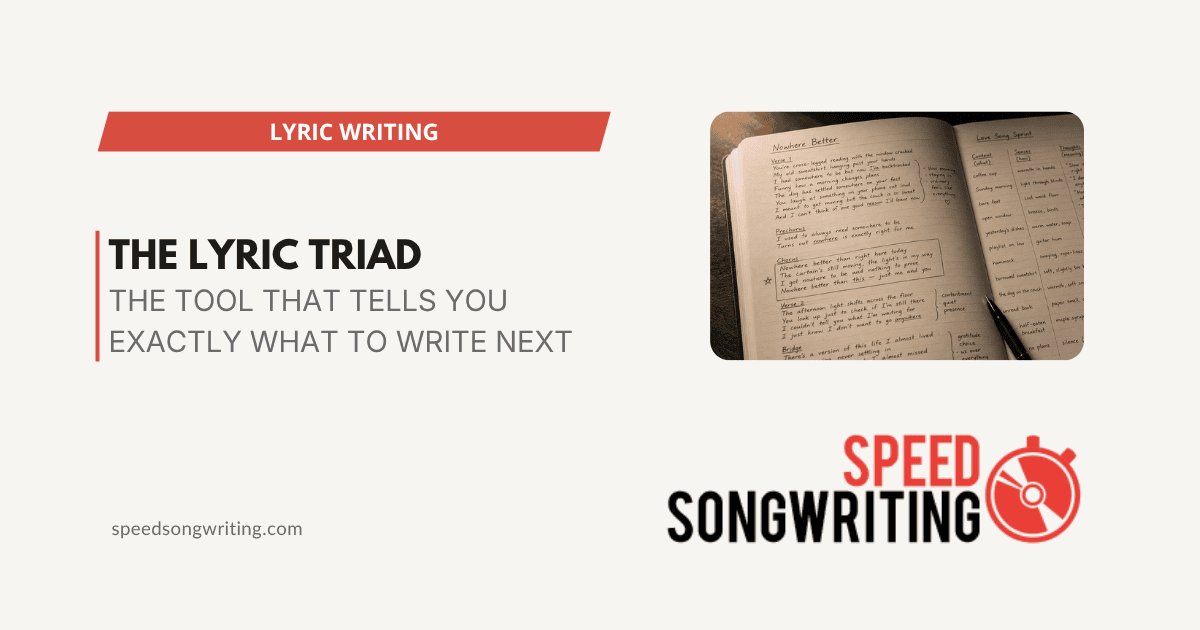
Lyrics fall flat in predictable ways.
Some lyrics feel vague: emotional but nothing concrete to hold onto.
Others land hard in the scene but never earn an emotional response.
The Lyric Triad fixes that. It's a three-part system for generating song-ready words that give your lyrics detail, depth, and direction at the same time.
And it ends writer's block, because you always know what to write next.
Here's where it came from, and how to use it.
Where the Lyric Triad Came From
I didn't invent the pieces. I connected them.
Pat Pattison at Berklee taught me object writing:
Pick any object and describe it using sensory details for a set amount of time.
That's it. It's simple, but effective. It trains your brain to think in concrete images, which is exactly what lyrics need.
Then Andrea Stolpe showed me a variation:
Instead of an object, write about a place.
Describe the external sensory details, then go internal and describe your thoughts and feelings about it.
More nuanced, more emotionally layered.
I'd seen that pattern somewhere before. Then it clicked:
My Neuro-Linguistic Programming training. (NLP, bear with me.)
In 2004, I became an NLP Master Practitioner, using it to study peak performance in myself and my students.
One of the core frameworks was "categories of experience."
Three categories:
- Content
- Representational Systems
- Neuro-Logical Levels
Or in plain language: stuff, senses, and thoughts.
And here's the part that changed everything for me...
Each category has six sub-categories:
- Six types of content
- Six senses
- Six levels of thought
I thought, why not expand on what Pat and Andrea taught?
Instead of being limited to one object or one place, I could choose from any of the six content types.
When I wanted to describe that content, I had all six senses available.
And when I wanted to go internal, I had six levels of thought to draw from.
With 18 angles on any song idea, the blank page stops being a problem.
That's the Lyric Triad: Content, Senses, and Thoughts, with six sub-categories each, giving you 18 angles on any song idea at any moment.
The Three Parts
The Lyric Triad has three parts. Together, they cover everything a lyric can be:
- Who and what
- Content is what you write about.
- How it looks and feels
- Senses are the factual, external descriptions of that content.
- Why it matters
- Thoughts are the singer's internal experience of that content.
Lyrics that fall flat are missing at least one of these. All three together make a lyric vivid, specific, and emotionally true.
Let's go through each one.
Content: The 6 Types
Content is your raw material. It's the subject matter: the nouns at the center of the song. Here are the six types:
People (Who, Relations)
People are relationships and names: sisters, bosses, dancers, the one who left, the one who stayed. If you're writing about a person or a relationship, it lives here.
Things (What, Get, Have)
Things are objects: the physical stuff of the world. Homes, cars, phones, photographs, rings. Concrete things carry emotional weight precisely because they're specific.
Activities (How, Do)
Activities are the things people do: fighting, getting married, driving too fast, making dinner, falling asleep on the couch. Actions move a song forward.
Information (Why, How, Know)
Information is knowledge: the ideas, beliefs, philosophies, and facts inside the song. What does the narrator know? What do they understand or misunderstand?
Place (Where, Be)
Place is location: cities, rooms, parking lots, the back porch, the bar at closing time. Place grounds the listener and sets the scene.
Time (When)
Time answers when: summer of 2009, the morning after, every Sunday, right now, too late. Time creates context and urgency.
Pick any content type as your starting point. Each one opens a different door into the song.
Senses: The 6 Types
Senses are the external, factual descriptions of your content. You're a reporter. Describe what's there: what any observer could see, hear, touch, smell, or taste. Senses make the listener feel present in the song.
There are six:
Kinesthetic: Proprioception
This is your body's awareness of itself: tight muscles, heavy limbs, floating, that dizzy feeling when something goes wrong. Proprioception is the sense most often missing from lyrics, and it's the most viscerally connecting one you have. Use it.
Kinesthetic: Tactile
How things feel to the touch: rough, smooth, cold, soft, prickly. The physical texture of the world the song lives in.
Visual
Everything you see: colors, shapes, movement, stillness, light and shadow. Visual detail is the most common sense in lyrics, and because of that, leaning on the others tends to make a lyric stand out.
Auditory
Everything you hear: voices, sounds, silence, music playing in another room, footsteps, traffic. Auditory details are often underused.
Olfactory
Everything you smell. Smell is the sense most directly tied to emotional memory. Use it carefully and sparingly, and it'll hit harder than almost anything else in the lyric.
Gustatory
Everything you taste. The rarest sense in lyrics, which is exactly why it lands so well when it shows up.
Thoughts: The 6 Levels
Thoughts are the singer's internal experience of the content: the layer of meaning that senses can't reach on their own. The Lyric Triad draws from six levels of thought, moving from the surface inward:
Environment
How the place or situation affects you. "This city makes me smaller." "The quiet here is louder than anything."
Behavior
What you're doing and why. The actions that reveal the emotional state without naming it directly.
Capabilities
What you're able to do, or no longer able to do. This is often where the core tension of a song lives: "I can't stay. I don't know how to leave."
Beliefs
What you hold to be true about the world, this situation, or yourself. Beliefs carry conviction. They're where the chorus often lives.
Identity
Who you are, or who you've become, or who you refuse to be. Identity statements hit at the deepest level of the Thoughts category. "I'm not the kind of person who stays." "This is who I am now."
Collective
What you share with others: the universal experience inside the personal one. This is how a song about one specific breakup becomes a song that everyone in the room recognizes as their own.
The further down this list you go, the deeper the lyric cuts. Most song verses work through the upper levels. Choruses tend to operate at the Beliefs and Identity level. Bridges often reach Collective.
Free Download: Speed Songwriting Cheat Sheet
The 7-step method in a single reference page — so you always know exactly where to start and what to do next. Free PDF, instant download.
The 250-Word Exercise
Here's how to use the Lyric Triad to fill a blank page in 10 to 15 minutes or less.
Put your song title into Google Image Search. You could use a key image from the song plot instead: any visual that connects to the concept. Describing what you actually see is faster and more concrete than imagining it.
Now go through the Lyric Triad:
First, describe what you see using the six senses. What's kinesthetically present:
- Is there weight, warmth, tension?
- What's the visual?
- Is there sound?
- Any smell or taste implied?
Write short phrases, not sentences: you're building word-and-phrase material, not lines yet.
Then work through the six Levels of Experience. Ask yourself what the content means at each level.
- How does it affect you (Environment)?
- What are you doing (Behavior)?
- What can or can't you do (Capabilities)?
- What do you believe about it (Beliefs)?
- Who does it make you (Identity)?
- What does it share with everyone (Collective)?
Write short phrases, fragments, images, and half-lines. In 10 to 15 minutes, you should have 250 words, which is more than enough raw material to write the song.
This word bank is your palette of color and tone. You'll pull from it through every remaining step of the process.
Lyric Triad Patterns
Once you have your word bank, the Lyric Triad becomes a sequencing tool. You can arrange Sense (S) and Thought (T) details in deliberate patterns to control how each section lands.
The classic pattern is SSST: three sensory lines followed by one internal thought.
You've heard this your whole life:
Roses are red
Violets are blue
Sugar is sweet
And so are you
Three external images, then the turn. The thought hits harder because of the setup.
Other patterns (S = Sense detail, T = Thought detail):
Two-line sections:
- ST: setup and meaning in two lines
- TT: pure internal, works for a bridge or a direct chorus statementTT — pure internal, works for a bridge or a direct chorus statement
Four-line sections:
- STST: alternating, builds a rhythm of image and meaning
- SSTT: two images, then two levels of thought
- SSST: the classic
- TSST: thought-first, grounded in two senses, closed with thought
Six-line sections:
- SSTSST: image, image, meaning, image, image, meaning
- STSSTS: more alternating, more conversational feel
- TSTTST: thought-led, good for a bridge that's processing something
Try your rhyme pairs inside a few of these patterns and see which combinations feel right. Simple usually works better than complex. One well-placed thought after three sensory lines will carry more weight than six lines all trying to say something.
The reason it ends writer's block is because of the process, not motivation.
When you sit down with no process, the blank page asks you to do everything at once:
Pick a subject, find the emotion, come up with a memorable image, make it rhyme, and make it true.
That's too many decisions running simultaneously.
The Lyric Triad separates those decisions.
You work through Content first to define the subject, then Senses to describe it from the outside, then Thoughts to find what it means. One thing at a time.
You always know what to write next. And when you always know what to write next, you write.
Keep Going
The Lyric Triad is Step 2 of the 7-Step Speed Songwriting System. If you haven't read the full system breakdown yet, start there.
Step 3 is finding your rhyme pairs, and Perfect Rhyme, Family Rhyme, and Slant Rhyme breaks that down.
When you're ready to see how Song Plots plug in at Step 1, Song Plots has the full breakdown.
Related Resources:
The 7-Step Method That Helps You Actually Finish a Song
Most songwriters have more ideas than finished songs. This free guide shows you the exact sequence to take an idea from start to done — without the rewriting loop or the blank-page panic.
Enter your name and email and I'll send it right to your inbox.
No spam. Just useful things for songwriters.
Leave a Reply