
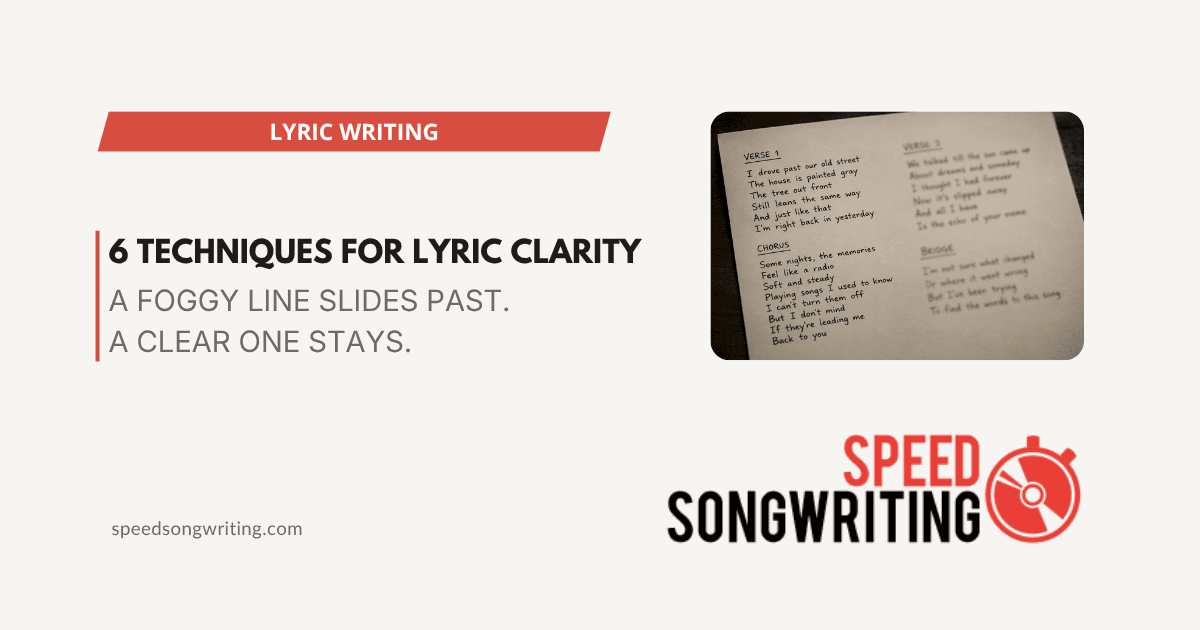
Clarity is what makes a lyric resonate and stick.
A foggy line slides right past you. A vague chorus fades by the second play. A clear one grabs attention, stirs emotion, and stays in the listener's head long after the song ends.
Here are six ways to get there.
1. Replace Abstract Words with Concrete Images
We all love big emotional words like "love," "hate," and "fear," but they're lazy placeholders. Your audience doesn't feel "love." They feel the moments that express it.
Instead of "She felt love," paint the picture: "She hugged him tightly." Now it's real, something we can see and almost touch.
Try this. Take a line from your draft, circle every abstract word, and rewrite it with a concrete image or action. "I'm afraid of losing you" could become "I grip the phone, my hands shake."
(This is the sensory-detail move behind the psychology of songwriting: turn the abstract feeling into a physical image a listener can feel.)
Concrete lines stay with people. Abstract ones evaporate.
2. Use Specific Nouns
General nouns drain the color out of a story. "Car" is fine, but "beat-up red Chevy" is a memory. "Tree" works, but "twisted oak" paints a landscape.
Lean too hard on generic terms and the emotional punch gets diluted. So go specific. If you're writing about heartbreak, don't say "I walked through the park." Say "I walked past the rusted swing set where we kissed under the stars."
The specificity gives your audience something to latch onto, a detail that makes the story feel like theirs.
Next time you write, challenge yourself to replace every general noun in a verse with something vivid.
(Specific, concrete detail is exactly what the Lyric Triad is built to generate.)
3. Keep It Simple but Not Simplistic
Clarity means communicating complex emotions in a way people can actually follow. The trick is to strip your lines of clutter while keeping the depth.
The common mistake is packing too many ideas into one line. Instead of "I want to leave, but I can't, because the thought of being alone scares me," write "I want to leave, but the thought of the empty bed keeps me here."
Read your lyrics aloud. If you're tripping over words or losing breath halfway through a line, it's too complicated. Pare it down. Let the melody do some of the heavy work.
4. Use Strong Verbs to Drive Emotion
Adjectives are tempting, but they often dilute your message. Instead of describing an action, choose a verb that carries the emotional weight.
"He walked slowly" becomes "He trudged."
"She cried softly" turns into "She wept."
A strong verb makes a line dynamic. Instead of "The waves were loud," write "The waves crashed against the shore." You can feel the difference.
Scan your lyrics for any "is," "was," or "are" construction and swap it for an action verb. Watch how much life your lines gain.
5. Cut the Fluff and Leave Oxygen
A crowded verse suffocates its own emotional impact. Pile on too many words and there's no room left to feel anything. Leave space, both for the listener and for the melody.
Take an overstuffed line:
"I'm standing in the rain, and it's cold, and I feel like I'm losing my mind thinking of you."
Now trim the excess:
"Standing in the rain, losing my mind."
The simpler version gives the listener room to feel. That's oxygen.
To practice, take a dense verse and cut it in half. Focus on the essential ideas and watch the lyric breathe.
(This is the same economy Say More With Fewer Words is built around.)
6. Anchor Big Themes with Recurring Imagery
Big themes like love, loss, or transformation slide into cliché fast when nothing grounds them. Recurring imagery anchors them by giving your song an emotional throughline.
If your song is about heartbreak, you might run water imagery through it, echoing drowning, waves, and tears:
- Verse: "The tide is pulling me under."
- Chorus: "I feel your waves crashing into me."
- Bridge: "I'm treading water, but I'm sinking fast."
Woven this way, the imagery creates a sense of progression and resolution across the song.
Pick one strong image and thread it through the whole thing.
Final Thoughts
Enhancing lyric clarity is about making your words hit harder, land longer, and connect deeper.
Trade abstract words for images. Name your nouns. Cut the fluff, pick verbs that punch, and leave the listener room to breathe. Then tie it all together with an image that recurs.
Lyric writing is part art, part craft. These six techniques hand you the craft. The art is up to you.
(Make them stick by building them into your routine with these 7 daily habits that will instantly improve your lyrics.)
The 7-Step Method That Helps You Actually Finish a Song
Most songwriters have more ideas than finished songs. This free guide shows you the exact sequence to take an idea from start to done — without the rewriting loop or the blank-page panic.
Enter your name and email and I'll send it right to your inbox.
No spam. Just useful things for songwriters.
these ideas are fantastic.
Thanks, Joe! Glad you found them helpful. Hope they spark some great lyrics for you!
Thank you so much! Very informative such a great help, absolutely. From the Philippines.
Thank you! So glad it helped. Sending creative vibes to the Philippines!
Recurring imagery is something I never thought about. Wow. Very cool idea!! Thanks.
Glad it clicked for you!
That was helpful.
Cheers, Lloyd!
nice…this is the help i need
That’s great to hear. Appreciate you!
Somehow you hit me with the right advice in the right moment. Thanks!
Love hearing that, Joe! Right time, right advice is sometimes all it takes. Thanks for the comment!