
A song idea has a shelf life.
The emotional charge that made it worth writing starts fading the moment you stop working on it, and by the third day, the thread has usually snapped. The voice memo is still on your phone. The reason it mattered is gone.
Speed Songwriting calls that Inspiration Decay, and it's the reason writing faster produces better songs rather than sloppier ones. Speed protects the feeling.
These seven techniques run in session order, from capturing a raw idea to closing the session with the next move already decided.
1. The 2-Minute Rule
Capture any new idea within about two minutes of having it, using a tool that requires no setup: Voice Memos, the Notes app, a pocket notebook.
Two minutes is not an arbitrary number. It's roughly how long it takes for the analytical part of your brain to catch up and start asking whether the idea is any good. Capture before that happens, and you get the raw essence. Wait, and you get a version your brain has already negotiated down.
Record the essence. Sing the hook, say the title out loud, play the chord once if there is one. Refine later.
The blank page is the single most expensive thing in songwriting, and this is how you stop facing one. A songwriter with forty captured ideas starts sessions in a different position than a songwriter with none.
2. The 3x3 Filter
Not every captured idea deserves a session. The 3x3 Filter is a triage tool: three questions, and two yeses to proceed.
- Does it still spark something when you play it back?
- Can you play it from memory?
- Does it fit the style and goals you're working in right now?
Two out of three means it's worth finishing. One or zero means it goes back in the pile without guilt, and you move to the next one.
The second question does more work than it looks like it does. If you can't play an idea from memory a week later, that's information about the idea, not about your memory.

3. The 90-Second Loop Test
Loop the idea for ninety seconds and sing nonsense over it. Syllables, vowels, whatever falls out. No real words.
What you're listening for is melody, phrasing, and vowel shapes: where the line wants to sit, where it wants to breathe, which syllables land on the strong beats. Melody before meaning.
Songwriters lose hours writing a lyric first and then bending the melody around it. Nonsense singing surfaces the shape in a minute and a half, and the words go into a shape that's already working.
4. The Constraint Stack
Pick one constraint before the session starts. Only four lines. One new chord. No editing until the draft is done. One key, one tempo, locked.
A constraint works by reducing the number of open decisions in front of you, and open decisions are where sessions go to die. Every choice you remove in advance is a choice you don't spend twenty minutes on at 11 PM.
If one constraint doesn't produce enough friction, stack a second. Four lines and no editing. The stack is adjustable, and most songwriters find their productive setting after two or three sessions of experimenting.
5. Finish Ugly
Draft the whole song in one pass, roughly forty-five minutes, with a beginning, a middle, and an end. Leave placeholders where the words aren't there yet. Don't stop to fix anything.
This is the technique people resist hardest and benefit from most. A finished rough draft is a thing you can work on, while a half-perfect fragment is a thing you can only stare at.
When a section stalls, write something deliberately bad in the gap and keep moving. You'll fix it in ten seconds on the next pass, because by then you'll be able to hear what the section is supposed to do.
Finishing ugly is how a song stays inside the window where the feeling that started it is still available to you.
6. The 80% Rule
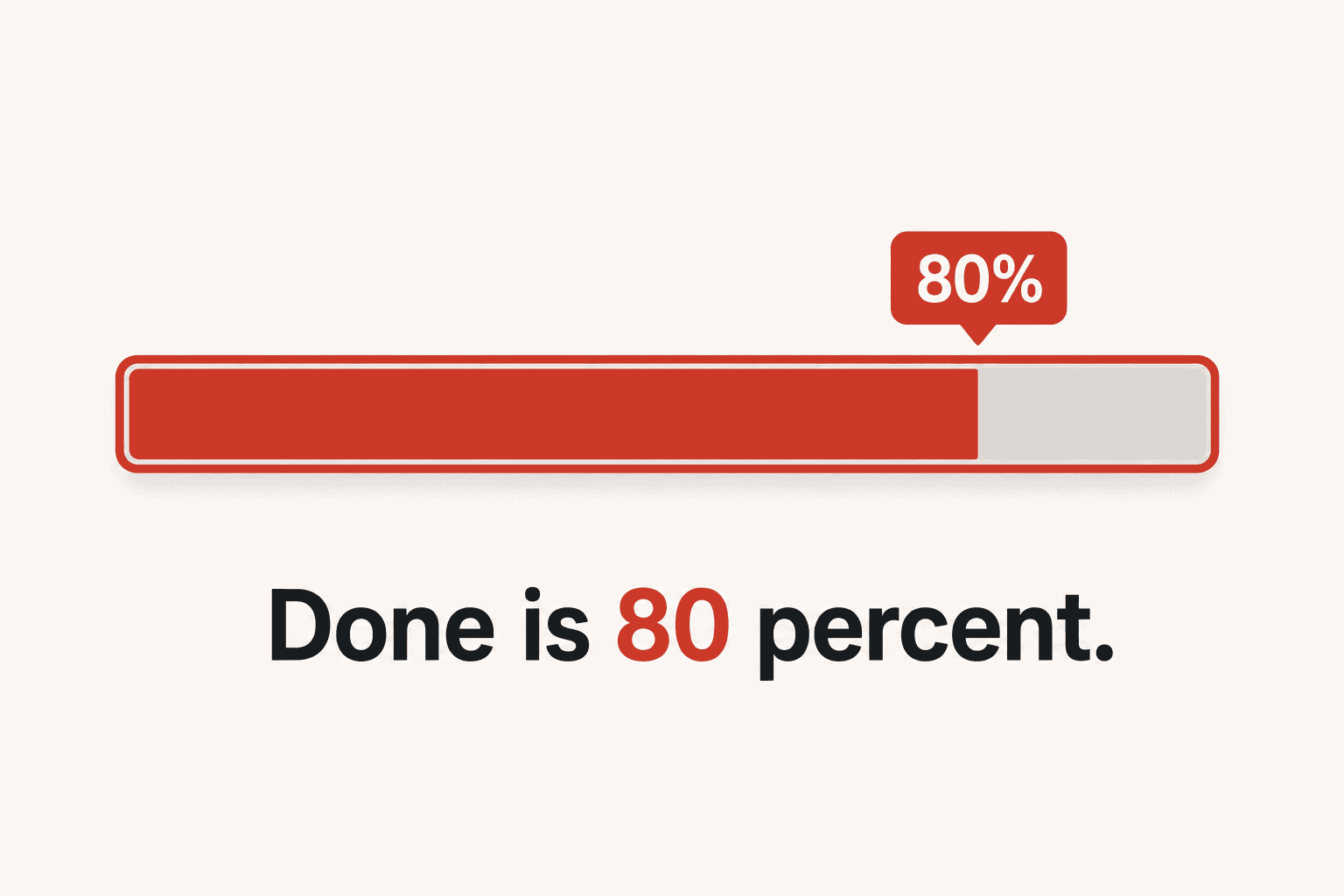
Call a song done at eighty percent.
The final twenty percent is where perfectionism lives, and momentum dies. It's the endless comping, the fourth alternate lyric for line three, and the mix note you'll change back next week. That twenty percent absorbs more hours than the first eighty and improves the song less than a second finished song would.
Eighty percent means the song has its structure, its hook, its lyric, and a bounce you can play for someone. Bounce it and name it, then go start the next one.
7. The One-Sentence Close
End every session by writing one sentence: where you stopped, and what the next action is.
"Second verse has three lines, next thing is the fourth line and a scratch vocal on the chorus."
The sentence closes the open loop. Without it, the song sits in the back of your mind all week as unfinished business, and the next session starts with fifteen minutes of listening back and reorienting. With it, you sit down and start working.
It takes a few seconds and is the highest-return habit on the list.
Want these seven in a printable form? The Speed Songwriting cheat sheet puts the filter questions, the constraint list, and the session-close prompt on one page you can keep on the music stand.
One More Thing
Track your Time to First Draft.
TTFD is the average number of minutes between a blank page and a complete rough draft. Time it for a month, write the number down after each session, and watch it come down. Most songwriters can get it under sixty minutes without any change in the quality of what comes out.
The reason the number moves is worth understanding, because it explains why these seven techniques compound rather than stack. Each one removes a specific decision from the session: what to work on, what the melody does, how many lines, when to stop, what happens next. Songwriting runs slow because deciding runs slow, and a song presents a few hundred decisions, most of which don't matter.
Take the decisions out and the song arrives at the same quality in a fraction of the time, with the feeling that started it still intact.
That's the whole method. The 8-Week System runs it end to end if you want the structured version.
Your Speed Songwriting Coach,
Graham English
FAQ
How long should it take to write a song?
A complete rough draft is realistic in forty-five to sixty minutes once you're working under constraints and drafting without editing. Polishing takes longer and varies by song, though the 80% Rule suggests most of it isn't worth doing.
Does writing faster mean writing worse songs?
Speed protects the emotional charge behind the idea, which is the thing that made the song worth writing. A draft finished inside that window usually carries more of the original feeling than one you assemble over three weeks.
What is the 3x3 Filter?
A triage tool for deciding which captured ideas deserve a full session. Ask whether the idea still sparks something, whether you can play it from memory, and whether it fits your current style and goals. Two yeses out of three means it's worth finishing.
What should I do when a section stalls mid-draft?
Write something deliberately bad in the gap and keep going to the end of the song. The stalled section is almost always easier to solve once the sections around it exist.
How do I stop overthinking my lyrics?
Find the melody first. Loop the idea for ninety seconds, sing nonsense over it, and let the phrasing and vowel shapes emerge before you write a single real word.
The 7-Step Method That Helps You Actually Finish a Song
Most songwriters have more ideas than finished songs. This free guide shows you the exact sequence to take an idea from start to done — without the rewriting loop or the blank-page panic.
Enter your name and email and I'll send it right to your inbox.
No spam. Just useful things for songwriters.
Leave a Reply