
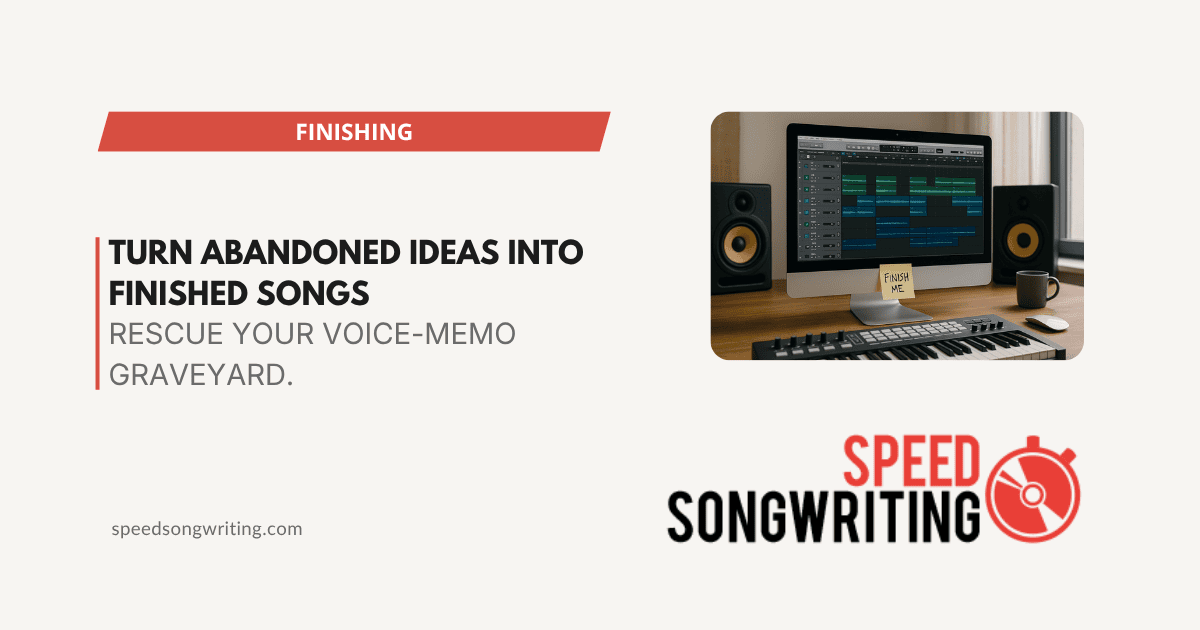
Every songwriter has one: the voice memo graveyard. Dozens, maybe hundreds, of half-finished hooks, lyric fragments, and 12-second "genius moments" that never see the light of day.
They're not bad ideas. They're just unfinished. (If that backlog has you frozen, you may be stuck in Songwriter Limbo.)
The good news is you can rescue them. With the right system, those scraps can become a finished, proud-to-share song in record time.
Below are seven battle-tested techniques I teach in the Speed Songwriting Method, each one designed to move an idea from "dead in your notes app" to "on repeat in your DAW."
1. The "Finish Ugly" Rule
Perfectionism is why most ideas die in your drafts. Instead, commit to finishing one rough draft fast.
(Perfectionism is sneaky enough to deserve its own diagnosis: 4 signs it's ruining your songwriting. The same finish-first instinct powers the 80% Rule too.)
How to do it:
- Open a voice memo or lyric scrap.
- Give yourself 45 minutes to create a beginning, middle, and end.
- No overthinking, no tweaking, no "maybe I'll just EQ this vocal."
Example:
I once worked with a songwriter who had a haunting 8-bar piano loop gathering digital dust for 6 months. We put it on a timer, forced a verse-chorus-bridge skeleton, and by the end of the hour he had a full demo. Not perfect, but a song.
Template:
[Verse 1] Rough in melody + placeholder lyrics
[Chorus] Repeatable hook
[Verse 2] Mirror structure of Verse 1
[Bridge] Contrast in chords or rhythm
[Chorus] Repeat
Momentum beats perfection every single time.
2. The 3x3 Filter
Not every abandoned idea deserves CPR. This filter helps you pick winners fast.
Ask these 3 questions:
- Does it spark emotion (even in its rough state)?
- Can I hum or play it from memory?
- Does it fit with my current style or goals?
If you get at least 2 out of 3 yeses, it's worth finishing.
Example:
A client applied the 3x3 filter to 40 unfinished voice memos. Only 7 passed. She finished 5 of them in a month and released 3. That's 3 real songs instead of 40 dead files.
3. Lyric Laddering
Many abandoned songs get stuck on words. Lyric Laddering unblocks you by turning fragments into full sections.
(For a deeper system for writing vivid, specific lyrics, pair this with The Lyric Triad.)
How to do it:
- Write your hook line at the top of the page.
- Under it, list 3 ways to explain it (story, metaphor, direct statement).
- Expand each one into a lyric ladder: 3 short lines that climb to the hook.
Example:
Hook: "I burn brighter in the dark."
- Story: "Match in the wind / Candle in the storm / I burn brighter in the dark."
- Metaphor: "Star in a dead sky / Moon with no tide / I burn brighter in the dark."
This turns a single phrase into full verse material, fast.
4. The "90-Second Loop Test"
Loop your idea for 90 seconds and record yourself singing nonsense over it. No words, no rules.
Why it works:
Melody comes before meaning. You'll uncover natural phrasing, rhythm, and vowel shapes without the pressure of "real" lyrics.
Example:
One student looped a 4-chord piano riff and babbled for 2 minutes. Out came a melody contour that became their chorus hook. We replaced "yeah-yeah-woah" with real lyrics later, but the energy was already there.
5. The Constraint Stack
Constraints kill procrastination. Apply one constraint per session until the song is done.
Options:
- Write the next section using only 4 lines.
- Use a chord you've never played before.
- Ban editing until the end.
Example:
A songwriter used "no editing until done" to finish a verse in 12 minutes, then added "only 4 chords" to write the chorus in 15. Two constraints, one finished draft.
6. The Song Splitter
When a song feels too big to finish, split it.
How to do it:
- Extract the hook and finish it as a 60-second "mini song."
- Once it works, expand it with verses and a bridge.
Example:
One producer had a massive 32-bar beat that went nowhere. We cut it down to a single hook and chorus loop, finished it, then rebuilt the full song around it in an afternoon.
7. Schedule the "Finish Session"
Ideas die because they never get a calendar slot. Treat finishing like a deadline.
Steps:
- Pick 1 abandoned song.
- Book a 1-hour "finishing session" (no interruptions).
- Use the "Finish Ugly" Rule and the 3x3 Filter.
- Export a rough bounce, even if it's scratch vocals and a basic beat.
When it's on your calendar, it happens. Period.
Your Next Step
Open your Voice Memo app, pick one idea, use "Finish Ugly" and schedule your first 1-hour finish session today.
By this time next week, you could have a song instead of a graveyard full of fragments.
(Want the whole sequence in session order? Seven techniques run an idea from capture to finished draft in one sitting.)
And if you want my full framework for turning scraps into finished songs, the Speed Songwriting Cheat Sheet gives you the exact templates and daily workflow I use with every client. Ready to push further? Why writing 10 bad songs is the fastest path to 1 good one shows you how to turn this rescue habit into a full sprint.
Stop hoarding and start finishing. Your next favorite song is already waiting.
The 7-Step Method That Helps You Actually Finish a Song
Most songwriters have more ideas than finished songs. This free guide shows you the exact sequence to take an idea from start to done — without the rewriting loop or the blank-page panic.
Enter your name and email and I'll send it right to your inbox.
No spam. Just useful things for songwriters.
Great guide Graham, thanks. I have a notes folder with dozens of ideas, and a voice memo app with hundreds. I’m an old man but I think there’s time to finish some songs!
That’s exactly the right attitude, and yes, there’s time. A notes folder and hundreds of voice memos is a goldmine. Most people are missing the raw material. You’ve already got it. Now it’s just finishing.
Pick one that still tugs at you and run it through the process.
Thank you for the kind words and encouragement. I’m on it!